Friday, 17 February 2017

What is a Hepatopancreas?

Cascais is a quiet, slightly upscale seaside town where Lisboetas and foreigners alike head to soak up the sun during the overly hot Portuguese summers. It was early December, so not much sun for us, but we were heading to Mar do Inferno, so the lack of UV radiation didn't bother us too much.


As you know, when you have unbeatably fresh seafood, you should not mess around with it. Keep it simple, execute it well and season precisely. Mar do Inferno, which means 'Sea of Fire', knows how to do these three things exceptionally well. We got the seafood platter for two – whole seabass, tiger prawns and (godly) carabineiro (red, Portuguese spelling) prawns all grilled and lathered with high quality olive oil, salt and garlic, with some boiled new potatoes and broccoli thrown in.
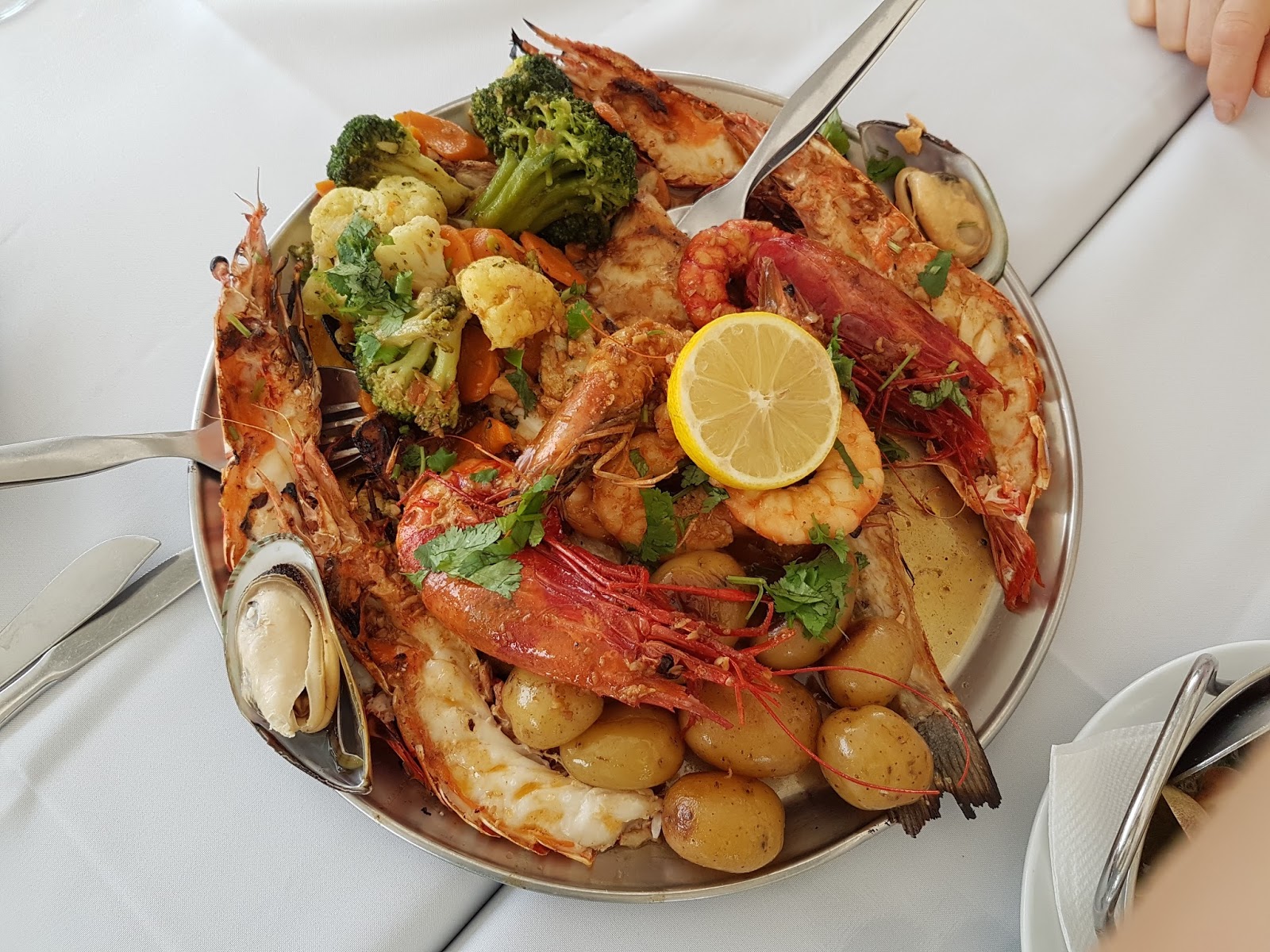

You might be getting bored of me writing about red prawns but I am adamant that this crustacean is one of the best anythings on the planet, never mind just the best prawn. Sweet juicy flesh. Unctuous, creamy roe. And better-than-foie gras prawn Hepatopancreas (the unctuously gooey stuff inside the head) - well, that stuff lacks superlatives. Notice how I used to just call it prawn head fat, but now, I've decided to get a bit technical. The hepatopancreas of a Carabineiro prawn – words worth remembering.


Kind of blew away the tiger prawns, which were also excellent, by the way. The seabass was as fresh as expected but if I could find one criticism of our meal was that the fish was slightly overcooked – maybe the result of lying under a mound of piping hot prawns.


Their clams cooked 'bulhao pato' – that is with garlic, butter and parley – were also excellent, with the sweetness of the clams not dominated by the extrovert garlic, a balance is is easier said than done.

Now, you might be thinking, fresh seafood in a slightly upscale seaside town, especially including red prawns, equals expensive. But no – seafood platter for two, which in fact fed three, only 79 Euros, clams, 15 euros, and excellent wine, around 15 euros. Combine this with good service, great vistas of the Atlantic Coast mean that all in all it is pretty hard to fault this place, and definitely worth the small excursion out of Lisboa.


Address: Restaurante Mar do Inferno (Cascais e Estoril), Avenida Rei Humberto II Itália
2750-800 CASCAIS
Phone: +351 21 483 2218
Opening hours: Thurs – Tues 12.30 – 10.30pm
Closed Wednesdays

Proper Piri Piri

Nandos has been selling us a rather twisted, albeit kind of tasty, version of 'Piri piri chicken' for the best part of a decade. As you'll discover upon sampling the food at Lisbon's numerous tabernas, the Portuguese don't take too well to fiery chilli heat. So the notion of grilled chicken smothered in pretty spicy sauce being authentically Portuguese might seem like throwing a tiger amongst the chickens.


As with most of my food trips, I run out of time to eat everything I originally intend to eat – but since my last visit did not spare me sufficient time to try the real piri piri, this time, I had no choice. Frangasquiera Nacional, which basically means National Grilled Chicken Shop, looked like my kind of place – simple, uncomplicated, with a focus on doing what they do best – grilled chicken, Portuguese style.


Unlike Nando's whose chickens are pre cooked then finished on the grill, this place takes raw, whole chickens, seasons them appropriately and places them atop a charcoal grill. No spicy, overly salty 'piri piri' sauce here. That's not the way the Portuguese do it. Nacional's piri piri sauce is just a mild chilli oil lathered on the chicken post-grilling. That's all.


The result – smokey, crisp on the outside chicken, with juicy interior, with only the subtlest hint of spice. No complicated flavour profiles or anything spectacular. But tasty, honest charcoal grilled chicken – which, in my eyes, can only be a good thing, especially when executed this well. To accompany your bird, get some of their home-made chips – now I'm using the American definition of chips here – hot and uber crunchy, lightly dusted with salt and the ingeniously interesting addition of dried marjoram.


The only downside is that this place is takeaway only – but then again, order a chicken or two, chips and some beer, retreat to the comfort of your hotel, watch some TV, soak in the bath if there is one, now that's a pretty good way to enjoy proper Piri Piri, no?

Frangasquiera Nacional
Address: R. da Imprensa Nacional 117, 1200-214 Lisboa, Portugal
Phone: +351 21 241 9937
Opening hours: Tues – Sun: 12 – 3pm, 6.30 – 10pm
Closed Mondays

When to trust Tripadvisor

Sometimes I really hesitate to follow Tripadvisor's advice. Sometimes I don't trust the reviews, or sometimes I'm too much of a snob and would happily go to the same place if only it was found on somebody's secretive blog somewhere and not on mainstream websites. But when backed up by solid reviews on yelp, google, facebook and other platforms, I should stop being that snob and just go try the food and make my judgment later on.


Upon entering Taberna Ruas das Flores, those doubts quickly dissolved away. A narrow, maybe 20-cover restaurant, slightly dark, mysterious with that distinctive 'local' feel, gave me some comfort. More reassuring was the menu, from which we ordered bacalhau (salt cod) with chickpeas, and roasted mackerel with coriander and potato.


The bacalhau, accompanied by perfectly cooked chickpeas, flavoured with paprika, olive oil and parsley, was just one of those tasty dishes that you might not write home about, but in no way you could fault either.


More stunning was the mackerel – of course, the mackerel was fittingly fresh, but the clever combination of uplifting coriander and earthy potato, with the ingenious addition of savoury-but-not-fishy dried shrimp really made it stand-out – not only for it's inherent umami-ness, but also for giving the dish an added crispy dimension. Very, very good cooking.


Complement such dishes with very fairly priced local wines, and you have good reason to believe all those Tripadvisor reviews.

Taberna Ruas das Flores
Address: Rua das Flores 103, 1200-194 Lisboa, Portugal
Phone: +351 21 347 9418
Opening Hours: Mon – Fri 12 – 11.30pm, Sat 6 – 11.30pm
Closed Sundays

Where to take your Chinese parents

So you bring your parents to a city for the first time. They don't like high-end eateries but the quality must be uncompromising. As all Chinese do, they like sharing and there must be sufficient choice. Lisbon's tabernas could've been a decent shout but depending on where you go, the menus can be quite limited. So I went for something which could've been a big hit or a big miss; the Timeout Market (Mercado da Ribeira), a food hall comprising of mini-restaurant versions of well-established, well-to-do eateries around Lisbon.


Even though online reviews are generally upbeat about this place, when I've been to similar concepts in other cities, sometimes the choice of vendors can really let the place down. The Timeout Market was actually pretty, no, very good in that regard – pretty much everything we tried was on point, tasty and not overly priced.


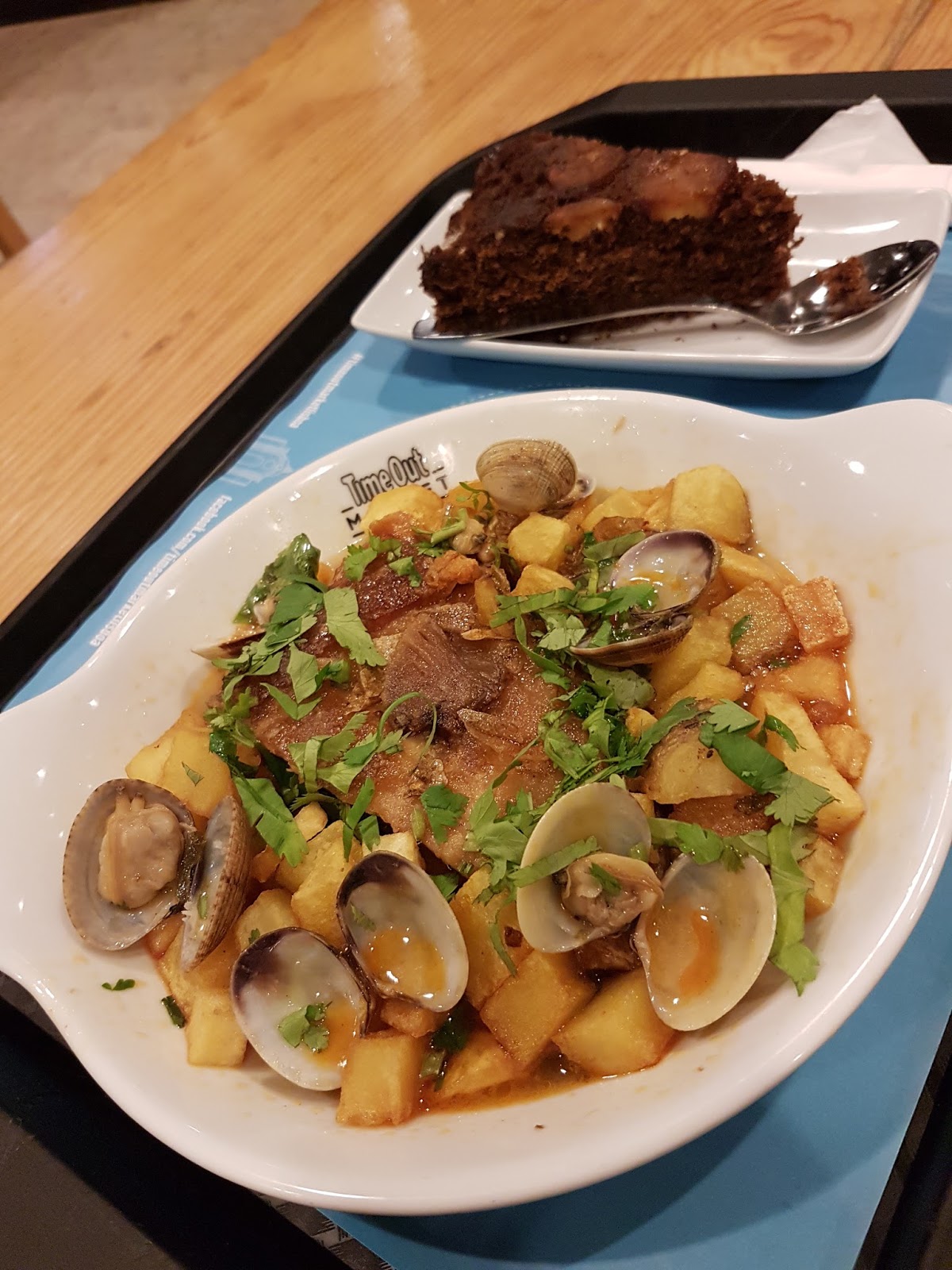
First up, the Wednesday special at Marlene Vieira – Coxinha de Chef – belly pork cooked with clams, potatoes and parsley, a banana cake and red wine for only 12.50 Euro. Not brilliant, but tasty, especially the pork, and definitely a bargain.


Then, our favourite stall, Alexandre Silva. Roasted bacalhau, boiled potatoes and spinach. Brilliantly flakey and fleshy salt cod, doused in olive oil with a touch of sea salt, a really great way to introduce my parents to Portuguese bacalhau. Quite a few of the stalls had a touch of Asian fusion, and this was no exception – as my dad is the king of rice, he was pretty happy with his black squid ink risotto, jazzed up with wakame seaweed and the freshest, melt in your mouth slices of sauteed scallop (which could have been bigger).


Not very Portuguese but very up my alley was the Sardine Nigiri Sushi at Sea Me (the two on the left of the pic below). This dish had a slightly heavy price tag, but it was accompanied by priceless spectrum of flavours – oily, rich sardine, charred on the outside with a blowtorch and brought to life by a few crystals of sea salt, atop slightly sweet and sour sushi rice. Really, really good stuff. I could say it matched some sushi I tried in Tokyo, but I won't, as I'm not a man of controversy, generally. Less memorable was their Cod and Almond nigiri sushi, which was lacking in both the simple, sophisticated and the punchy, bold flavour departments. Don't do what we did, get two portions of Sardine Nigiri Sushi instead.


There are many, many more choices available here, not as many as a Singaporean Hawker Centre but for European standards, it's pretty good. Go forth and discover this gem.

Mercado da Ribeira (Timeout Market)
Address: 481,, Av. 24 de Julho, 1200 Lisbon, Portugal
Opening hours: Sun – Weds: 10am – midnight; Thurs – Sat 10am – 2am


Sunday, 27 November 2016

Strange looking things that taste good

Noryangjin fish market. Could be a tourist trap or a foodie's delight. Unfortunately, the outcome depends on your bargaining skills, which are partially dependent on your language skills. Korean of course would be preferable, but it just so happens the aunties manning the more tourist-friendly part of the market are fluent in Mandarin Chinese, so that could be another avenue to avoid getting ripped off. I was lucky, my friend's mum guided us through the whole experience. Normally I love a challenge and I enjoy working hard for my food, but for once it was great, sitting back, getting ready to eat a plethora of delicious critters, albeit a bit unchallenging. I guess sometimes food adventures should require little or no effort.


First up. Abalone sashimi. Actually, I'm not a fan of abalone when it's cooked, in general. I am however, a big fan when it's really, really fresh, and really, really uncooked – i.e. in sashimi form. Sweet with the perfect balance of chew and bite, when dipped in a garlic-chilli sauce, is indulgence at its best.


Alongside the abalone came sashimi'ed sea squirt. Now, at first glance, you might be wondering whether this is an internal organ of an mythical beast or a gene-splicing experiment gone slightly amiss. I'd never tried it before, and all I knew was that Koreans like to add it to a variety of spicy dishes to add sweetness. At first, it was a bit too soft and even slightly slimey, but then the sweetness hit my tastebuds. It wasn't overpowering, and definitely had that very slightly briney edge, which made it a very satisfying kind of sweetness. 


Even better, the sweet aftertaste lingers for a while on the palate, and leaves a slightly 'iron'-esque feeling in your mouth (you know, after you eat too much spinach, but this is lighter and more pleasant). Highly recommended if you're looking to add a 'try a strange looking but delicious new type of seafood' to your new year's resolutions next year.


Then, the touristy thing. Sannakji, or live octopus, brutally dismembered in front of your eyes. (Yes, it was pretty uncensored, I could almost hear the octopus screaming, if these arthropods can scream that is.) Its chopped up corpse is mixed with a bit of sesame oil, then you pick up the still-wriggling tentacles, and place into your mouth. Remember to chew, I was advised. I did chew really really hard, but my mistake was unfortunately trying to put too much in my mouth. One tentacle managed to grip the outside of my lip, and wouldn't let go. For a dead octopus, it put up a pretty good fight. Taste wise, it was nice, slightly sweet and not overly chewy, but it wasn't a patch on the afore-eaten abalone and sea squirt.

Noryangjin Fisheries Wholesale Market (노량진수산물도매시장)
674 Nodeul-ro, Dongjak-gu, 서울특별시 South Korea
Open 24 hours – but best to go for an early lunch

Subtlety can be surprisingly addictive

I love my Jajangmyeon. These Chinese-Korean black bean noodles were introduced to me by one of my Korean friends when I first started to get immersed into this cuisine around seven years ago. They don't look pretty, and the description of noodles covered in black bean sauce doesn't really whet you appetite at first glance. But don't let that fool you, these noodles will grow on you, quickly, and soon you might even start to eat the instant noodle version (Chapaghetti) in places devoid of this comforting treat.


So, naturally, I had a make a pilgrimage to one of Seoul's most traditional Jajangmyeon eateries; Sinseonggak. When you see the humble, understated nature of this place, you immediately know two things: (1) they probably do one or two things much better than anyone else (2) they won't take shortcuts to produce a stunning plate of food. 


For those of you who may have eaten Jajangmyeon abroad, you might be used to a slightly sweet sauce. That's what I have been accustomed to, at least. So when I took my first bite of these noodles, I must admit, I found the sauce slightly bland. But then the flavours started to evolve on my palate. I appreciated the subtle saltiness of the black beans, the mild sweetness of the onions, the touch of richness from the pork – within a few bites I had realised that I had found a sauce which was unbelievably well balanced.


The hand-pulled noodles, made fresh everyday on the premises, were equally sublime. Slightly chewy, slippery and not too heavy, they act as the perfect carrier for the subtle-yet-addictive black sauce. The fried mandu (dumplings) were tasty but were no where near as stellar as the noodles. (On a future visit, I will definitely get the Tang Yu suk, or Chinese-Korean sweet and sour pork).


All in all, this place is really worth making a mini pilgrimage for. For a large bowl of Jajangmyeon, it'll make a very small dent in your wallet, at only 5000 Won. Don't expect fantastic ambiance, but expect homely hospitality and subtle-yet-addictive bowls of noodle goodness.

Sinseonggak 신성각
2-463 Singongdeok-dong, Mapo-gu, Seoul, South Korea (quite hard to find, address in Korean below):
서울시 마포구 신공덕동 2-463
Phone: 02-716-1210
Open Mon – Sat 11:30 – 19:30; Closed Sundays

Pork belly: Temporary, materialistic happiness

Two of the world's best inventions come together when one gets to lay their tongue on samgyeopsal, or barbequed pork belly, a Korean classic. For those of you familiar with Korean cuisine, the pork is normally sliced thinly and barbequed quickly, resulting in crispy pork belly. But I love the belly when it's crisp on the outside and juicy in the middle. 


Fortunately, samgyeopsal at 길목 (Gilmok) resolves this dilemma. By cutting the pork belly into chunky pieces only after a large slab has been cooking away for a bit on the barbeque, this allows the centre of each porky piece to stay most and juicy, whilst the outside can develop that smokey, charred and crispy exterior which most humans cannot resist.


It is great dipped in a bit of salt and eaten on its own, or placed in a piece of lettuce together with rice and doenjang (fermented Korean soy bean paste) and wolfed down. Both are excitingly indulgent in their own ways.


This restaurant also does a pretty good pork shoulder, though, for me, it's all about the belly. Wash down with soju and you'll be extremely happy, at least in that temporary, materialistic kind of way.


길목 (Gilmok)
10, Yeongdong-daero 129-gil, Gangnam-gu, Seoul
http://www.diningcode.com/profile.php?rid=xwpkfkrWvUeC&rank=9 

For once, meat wasn't the stand-out act

As you might have noticed from reading just a few of my posts, I'm a meat and seafood man. On rare occasions, I get distracted by unique ingredients such as Ube and Lucuma, but these occurrences are few and far between.

Jeonju, the foodie capital of Korea, is home to one of those rare occasions. The now world-renowned bibimbap (mixed rice with vegetables and chilli paste), originated from this city, and as ever, I had to go find the best, most original one. I normally prefer hole-in-the-wall type of restaurants, but Gajok Hwegwan was rated pretty highly by a number of bloggers, so I settled for this.


Not long after ordering the yukhwe (raw beef-topped) bibimbap set (15,000 won), a rather ridiculous amount of food arrived within my field of vision. Now straight to business - a hot, large metal bowl, containing rice, raw beef and egg yolk, and a plethora of fresh vegetables and the oh-so-important chilli paste (gochujang) – this is what I came to Jeonju for. After mixing up all the ingredients with my usual level of OCD thoroughness, I took my first bite. Just like my Jajangmyeon experience at Sinseonggak, it reminded me that often these dishes are slightly twisted over in the West to suit our often sugar-seeking palates. Too often over in Europe and the US, the gochujang used for bibimbap is a bit sweet, but in this undoubtedly more authentic version, it is much less sweet, and packs more of a punch. This allowed the sweetness of some of the other vegetables to come through more markedly, and left my palate in feeling satisfied in a very balanced kind of way. The beef, for once, didn't live long in my memory – in fact,  the more I ate, the more I appreciated the subtle interplay between the veggies, the rice and the chilli paste. Could I actually enjoy a vegetarian bibimbap?


The side dishes were overabundant but that is not a bad thing – particularly when one of them was a delightfully light egg souffle. At this point, as I was slightly sleep deprived after an overnight flight from Singapore, so I'm a little ashamed that I can't remember more about the side dishes, but I do remember the yellow mung bean jelly (right middle of the pic), the caramel-esque potato (bottom left) being not only tasty but providing the perfect counterbalance to the capsaicin-laced bibimbap.


Gajok Hwegwan 가족 회관
South Korea, Jeollabuk-do, Jeonju-si, Wansan-gu, Jungangdong 3(sam)-ga, 80
Open Daily 11:30 – 21:00

Ice Cold Bovine Refreshment

So you've probably established that the Koreans do meat pretty well. Especially beef. And they also do pretty good noodles too. So beef + noodles equalling something good might seem like a logically excellent combination. But did adding an ice cold bovine broth to the mix come to your mind? I would have guessed not.

Mulnaengmyeon, an originally North Korean dish from Pyeongyang, is exactly the refreshing, slurp-worthy bowl of beef-based deliciousness that you never knew you needed in your life. Actually, you probably need it even more if you're reading this in the midst of summer or some sweaty tropical urbanopolis in SE Asia. If you like a pure, unadulterated beef broth, with chewy buckwheat noodles, Asian pear, radish and cucumber, and of course cooked beef slices then mulnaengmyeon is for you.


At first, the cold beefyness is a little strong, but after a while, you learn how to appreciate the subtle interplays between the ingredients; the sweetness of the pear, the bitterness of the radish, and for some heat, add a little mustard.

If it's your first time trying this dish in Seoul, try it at Woo Lae Oak, a name synonymous with this bowl of noodles whose status ought to be elevated in the noodle world.

Woolaeoak
62-29 Changgyeonggung-ro, Jung-gu, 서울특별시 South Korea
Tues – Sun: 11.30am ; Closed Mondays
http://english.visitkorea.or.kr/enu/ATR/SI_EN_3_1_1_1.jsp?cid=349050 

Sunday, 14 August 2016

Intimidatingly Tasty

A large, half empty rice bag comes out of the kitchen. Rather than the ubiquitous staple eaten throughout Asia, something rather different is contained within. The side of the bag starts moving. The anticipation rises.


The bag is opened. A huge, blue black arthropod emerges. Bits of coconut follow. It looks at you, hissing, brandishing its enormous coconut-crushing claws. This is Kepiting Kelapa, or the coconut crab. It is an intimidating beast, but it looked intimidatingly tasty. City Extra, in the western part of Manado in Northern Sulawesi, is famous for how they cook this exquisite specimen of seafood.


Firstly, the sauce. Lemongrass, chilli, turmeric, galangal were all in abundance, alongside coconut milk. But the balance was close to perfect – not too spicy, and the flavours of the aromatics complemented the sweetness of the crab, rather than overpowering it.


The meat itself, like any crab, varies in sweetness and texture depending on what parts you choose to devour. The claw was supremely sweet and extremely meaty (understandable for a beast that needs to crush coconuts), the part leading up to the claw was lobster-esque, and the body was tender. But undoubtedly the best part was its eggs (found in the abdomen) which was dispersed amongst the sauce.


These eggs added a subtle sweetness and a slight umami hit to lift the sauce to an elevated level of flavour, and added a dimension of creaminess to the sauce. More tasty than intimidating.
Pair this with white rice, and kangkung cooked with papaya flower, and you have a meal fit for four kings and/or queens. At 1.2MM IDR, it is extremely pricey by local standards, but considering that this is one of those rarely eaten treats, it is well worth it. 


My only complaint would be that this meal took nearly one hour to prepare. Maybe it was because we arrived around 11am before most staff were ready, or maybe it was due to an epic struggle in the kitchen between chef and the eight-legged beast... But if you also have to endure a similarly lengthy wait, the view from the restaurant could be worse.


City Extra
Jl. Raya Tanawangko Kalasey, Manado, Sulawesi Utara 95116, Indonesia
Opening hours: Daily 10am – 10pm
+62 812-4226-5008
https://www.tripadvisor.co.uk/Restaurant_Review-g297721-d1034284-Reviews-City_Extra-Manado_North_Sulawesi_Sulawesi.html  

Tuesday, 5 April 2016

Prawn foie gras

Overall, the Sicilian red prawn (gamberi rossi) is still my favourite prawn of all time. But the river prawn, especially the big ones found in Thailand and Myanmar, are not too far off, especially when it comes to what's inside the head. The Sicilian red prawn's head is sweeter and has a more intense prawn flavour, whilst the river prawn's head fat is creamier and more comforting, almost like crustacean foie gras.


 In Bangkok you can find giant river prawns at various locations throughout the city, but at P'Aor, you can get them with a prawn-fat enriched tom yum noodle soup. Flavourful and aromatic, sweet and sour, the soup of this bowl of noodles is incredibly addictive. I did expect it to be a tad more spicy, though that would be my only criticism.


Also highly recommended is the river prawn with prawn fat-infused egg on rice. A really ingenious creation – the oily goodness inside the head is used to scramble eggs which is then dumped in a big river prawn and steamed rice. In fact, if the river prawn wasn't there, I would be perfectly happy eating eggy, prawny rice. Damn good.

But then again, all is so much better with the giant river prawn, especially when you scoop out the foie gras-esque head fat. Here is a blurry picture of this amazing substance:


P'Aor's drinks are not too bad either; I washed down this feast with some refreshing roselle flower juice.


Price: 100 – 150 baht per person (2 people sharing 3 dishes and a drink each)
P'Aor
68/51 Soi Petchaburi 5, Between Soi 5 – 7, Phaya Thai, Ratchathewi, Bangkok
Phone: 026129013
Open Tues – Sun 10am to 10pm. Best to go during lunch before all the river prawns are eaten up